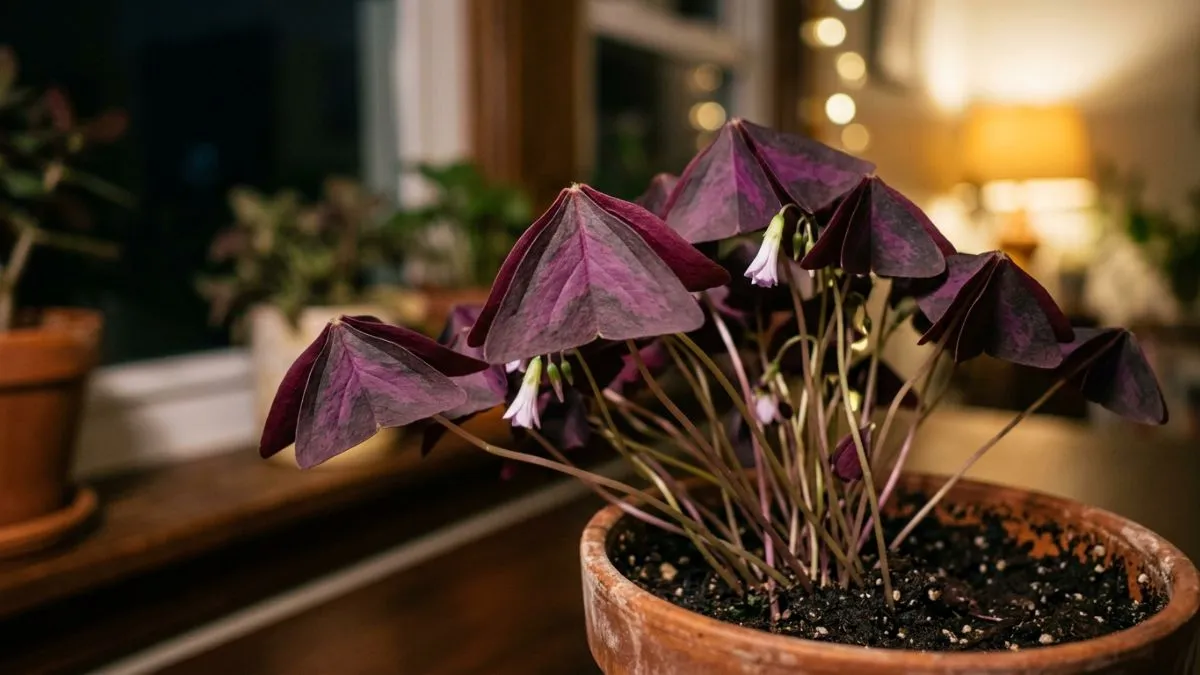
If you have ever checked a plant in the evening and noticed that its leaves have folded, drooped, or moved into a completely different position, you may have wondered whether something was wrong.
In many cases, nothing is wrong at all.
Some plants naturally change the position of their leaves as daylight fades. The movement can make a plant look as though it is going to sleep, but the behavior is part of a biological rhythm that helps the plant respond to its environment.
This phenomenon is known as nyctinasty, and it occurs in a surprising range of plants, including some familiar houseplants and garden species.
Why Do Some Plants Fold Their Leaves at Night?
Plants that close or reposition their leaves at night are responding primarily to changes in light and their internal biological clock.
During the day, leaves are positioned to capture sunlight for photosynthesis. When darkness arrives, certain plants change the angle or position of their leaves through specialized structures at the base of the leaf or leaflet.
These structures can control movement by changing the amount of water and pressure inside specific plant cells. As that internal pressure changes, parts of the leaf can move.
The result can be dramatic. A plant that looks completely open and upright during the afternoon may appear compact or folded several hours later.
The important point for gardeners is that this movement is not necessarily a response to stress.
If the leaves open normally again when daylight returns, the behavior is usually a natural part of the plant's daily cycle.
What Is Nyctinasty?
Nyctinasty is a type of rhythmic plant movement associated with the transition between day and night.
Unlike a plant simply wilting because it needs water, nyctinastic movement follows a predictable pattern. The leaves may rise, lower, fold together, or change their orientation as darkness approaches.
Plants do not have muscles like animals, so their movements happen through changes in cells and tissues.
One important structure involved in these movements is called the pulvinus. It is a specialized swelling found at the base of some leaves or leaflets. Changes in water pressure within cells in this area can cause the leaf to move.
This allows certain plants to repeatedly change leaf position without growing a new structure each time.
The movement can be surprisingly precise. A plant may close its leaves around roughly the same part of the day and reopen them after sunrise.
Do Plants Actually Sleep?
It is tempting to say that a plant is sleeping when its leaves close at night, but that comparison can be misleading.
Plants do have biological rhythms that continue through day and night, but they do not sleep in the same way humans or other animals do.
Instead, plants use internal circadian rhythms to coordinate many processes with the light-dark cycle.
Leaf movement is one visible example.
Plants also change their metabolism, gene activity, growth patterns, and other physiological processes according to these daily rhythms. The fact that a plant's leaves move at night is therefore one small part of a much larger biological system.
Calling it "sleeping" can be a useful way to describe what we see, but the underlying process is distinctly botanical.
Which Plants Close Their Leaves at Night?

One of the easiest ways to notice nyctinastic movement is to grow plants that naturally display it.
Oxalis is a particularly familiar example. Species such as purple shamrock can have leaves that fold or droop after dark and reopen when light returns.
Some members of the pea and bean family also display pronounced leaf movements. Their compound leaves can change position at night, sometimes producing a striking difference between the plant's daytime and nighttime appearance.
Sensitive plants are another famous example, although their movements are not exactly the same as ordinary nighttime leaf folding. Plants such as Mimosa pudica can move their leaves in response to touch, while also showing daily movements associated with the light-dark cycle.
This distinction matters because several different mechanisms can produce visible leaf movement.
A plant that closes when touched is responding to a mechanical stimulus. A plant that folds its leaves every evening is following a rhythmic environmental response. Some plants can do both.
Why Would a Plant Move Its Leaves at Night?
Scientists have proposed several possible advantages for nighttime leaf movements, although the exact function can vary between species.

One possibility is that changing leaf position helps reduce exposure to nighttime conditions. Another is that the movement may influence water loss, temperature, or the way leaves interact with moisture.
There is also evidence that leaf position can affect interactions with herbivores and other organisms.
However, gardeners should be cautious about simple explanations such as "plants close their leaves to protect themselves from cold." That may sound reasonable, but nighttime leaf movement is a complex trait, and its evolutionary purpose is not necessarily identical across all species.
The most reliable explanation is that these movements are controlled by biological rhythms and environmental signals, particularly changes in light.
The behavior has evolved in different plants for different reasons, and scientists continue to study how these movements benefit individual species.
Why Do the Leaves Open Again in the Morning?
The reopening of leaves is one of the clearest signs that the plant is following a natural daily rhythm.
As light returns, the cells responsible for leaf movement change their water balance and internal pressure. The leaf gradually returns to its daytime position.
This can happen before the plant receives strong direct sunlight. The internal biological clock helps prepare the plant for the transition between night and day.
That means a plant may begin opening its leaves around the same time each morning even when the exact amount of sunlight varies.
Light is an important signal, but the plant's internal circadian system also plays a role.
How Can You Tell Normal Nighttime Movement From a Problem?
This is where nighttime leaf movement can confuse new gardeners.
A plant that naturally folds its leaves at night should generally return to its normal appearance during the day. The movement should follow a relatively predictable pattern.
A plant that remains limp, collapsed, or unusually droopy throughout the daytime is different.
Persistent drooping can be associated with underwatering, root problems, excessive moisture, temperature stress, insufficient light, pests, or disease.
The leaves themselves can provide additional clues.
If the plant closes its leaves in the evening but looks firm and healthy the next morning, there is usually little reason for concern. If the leaves stay limp after daylight returns, begin turning yellow, develop spots, or show other changes, the problem may have nothing to do with normal nyctinastic movement.
This is why observing a plant at different times of day can be more useful than judging it from a single snapshot.
Light Can Change the Pattern
The daily movement of leaves is closely connected to the plant's perception of light, so changing its environment can sometimes change when the movement occurs.
An indoor plant exposed to artificial lighting late into the evening may experience a different light-dark cycle from a plant growing outdoors.
This can affect its biological rhythm.
For houseplants, that is another reason to avoid constantly changing the location or lighting schedule without a reason. Plants respond to their surroundings in ways that are not always immediately visible.
A consistent environment can make it easier to recognize what is normal for a particular plant.
A Leaf That Folds at Night Is Not a Sign of Weakness
The next time you see a plant closing its leaves after sunset, resist the urge to assume that it is thirsty or unhealthy.
For some species, folding leaves at night is simply part of their normal biology.
What looks like a plant going to sleep is actually the result of coordinated cellular movement, environmental signals, and an internal circadian rhythm. The leaves change position because the plant is responding to the transition from daylight to darkness.
That makes nighttime leaf movement one of the more fascinating reminders that plants are constantly responding to their surroundings, even when they appear completely still.
For gardeners, the easiest rule is simple: watch the pattern, not just the moment.
If the leaves fold at night, reopen during the day, and the plant otherwise looks healthy, there is a good chance you are seeing normal behavior rather than a problem.
And once you notice it, your garden may never look quite as still again.